GIS user technology news

News, Business, AI, Technology, IOS, Android, Google, Mobile, GIS, Crypto Currency, Economics

  • Advertising & Sponsored Posts
    • Advertising & Sponsored Posts
    • Submit Press
  • PRESS
    • Submit PR
    • Top Press
    • Business
    • Software
    • Hardware
    • UAV News
    • Mobile Technology
  • FEATURES
    • Around the Web
    • Social Media Features
    • EXPERTS & Guests
    • Tips
    • Infographics
  • Blog
  • Events
  • Shop
  • Tradepubs
  • CAREERS
You are here: Home / * PRESS / Business / Dubai Municipality Announces Launch of DMSat-1 Atmospheric Monitoring Microsatellite Built by Space Flight Laboratory (SFL)

Dubai Municipality Announces Launch of DMSat-1 Atmospheric Monitoring Microsatellite Built by Space Flight Laboratory (SFL)

March 23, 2021 By Editor

TORONTO, Ontario, Canada, 22 March 2021 – Dubai Municipality announced the successful launch and deployment of DMSat-1, an atmospheric monitoring microsatellite built by Space Flight Laboratory (SFL). DMSat-1 launched today from the Baikonur Cosmodrome in Kazakhstan aboard a Soyuz rocket.
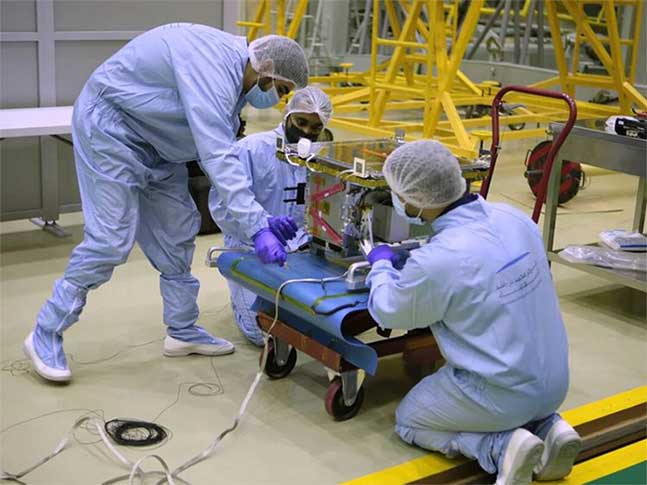
DMSat-1 being prepared for launch. (Courtesy GKLS and MBRSC)

DMSat-1 being prepared for launch. (Courtesy GKLS and MBRSC)

 SFL developed DMSat-1 under contract to the Dubai-based Mohammed Bin Rashid Space Centre (MBRSC) in the United Arab Emirates (UAE). The 15-kg microsatellite was built on SFL’s space-proven Next-generation Earth Monitoring and Observation (NEMO) platform.

 “We congratulate Dubai on the launch of its first atmospheric monitoring microsatellite,” said SFL Director, Dr. Robert E. Zee. “DMSat-1 will play a key role in monitoring atmospheric aerosols and greenhouse gases for Dubai and the UAE.

 SFL was selected to build DMSat-1 for its compact size and performance, including the mission-critical importance of attitude control and precise sensor pointing. SFL has developed high-performance ground target tracking capabilities that enable the small satellite to execute a slewing maneuver in orbit to accurately point its sensors at selected swaths of the atmosphere.

 “Our ability to keep low-inertia, relatively inexpensive microsatellites like DMSat-1 pointed accurately and stably in orbit has made atmospheric monitoring missions possible at much lower costs,” said Zee.

 DMSat-1 carries two instruments onboard. The primary payload is a multispectral polarimeter that monitors aerosols, which are typically fine particles of liquids and solids in the upper atmosphere often caused by anthropomorphic sources. Aerosols also correlate to natural phenomenon such as dust storms. The secondary payload is a pair of spectrometers for detection of greenhouse gases, such as carbon dioxide and methane.

 DMSat-1 is the 16th SFL-built satellite launched in the past seven months. These launches include missions developed for GHGSat Inc. of Montreal, HawkEye 360 of Virginia, Space-SI of Slovenia, and a Toronto-based telecommunications company. Today’s launch also included two communications satellites developed using SFL technology.

 SFL is a unique microspace provider that offers a complete suite of nano-, micro- and small satellites – including high-performance, low-cost CubeSats – that satisfy the needs of a broad range of mission types from 3 to 500 kilograms. Dating from 1998, SFL’s heritage of on-orbit successes includes 68 satellites and distinct missions related to Earth observation, atmospheric monitoring, ship tracking, communication, radio frequency (RF) geolocation, technology demonstration, space astronomy, solar physics, space plasma, and other scientific research.

 In its 23-year history, SFL has developed CubeSats, nanosatellites, and microsatellites that have achieved more than 140 cumulative years of operation in orbit. These microspace missions have included SFL’s trusted attitude control and, in some cases, formation-flying capabilities. Other core SFL-developed components include modular (scalable) power systems, onboard radios, flight computers, and control software.

 About Space Flight Laboratory (SFL) (www.utias-sfl.net)

SFL generates bigger returns from smaller, lower cost satellites. Small satellites built by SFL consistently push the performance envelope and disrupt the traditional cost paradigm. Satellites are built with advanced power systems, stringent attitude control and high-volume data capacity that are striking relative to the budget. SFL arranges launches globally and maintains a mission control center accessing ground stations worldwide. The pioneering and barrier-breaking work of SFL is a key enabler to tomorrow’s cost aggressive satellite constellations. (www.utias-sfl.net)

 Download the specification sheet for all SFL platforms here.

Filed Under: Business, Earth Imaging - Remote Sensing, Top Press Tagged With: Dubai

About Editor

Glenn is a geographer and a GIS professional with over 20 years experience in the industry. He's the co-founder of GISuser and several other technology web publications.

Top Press

The Global Expansion of Aueshah: A New Era of High Jewelry

April 11, 2026 By GISuser

KARACHI, PAKISTAN. The international luxury market is experiencing a profound shift. Consumers are increasingly rejecting mass-produced goods in favor of rarity, authenticity, and emotional depth. … [Read More...]

State of Data Science Report – AI and Open Source at Work

September 10, 2025 By GISuser

AI and Open Source at Work … [Read More...]

Topcon Announces Landmark Expansion of Topnet Live Network Across USA

January 26, 2025 By GISuser

LIVERMORE, Calif.---Topcon Positioning Systems has announced a significant expansion of its Topnet Live reference station network, introducing 200 new geodetic stations strategically positioned across … [Read More...]

Space Flight Laboratory (SFL) Announces Launch and Deployment of NorSat-4 Maritime Monitoring Microsatellite

January 19, 2025 By GISuser

Seventh Satellite Developed by SFL for Norway … [Read More...]

HERE and BMW Group extend partnership on AI-powered mapping system

January 8, 2025 By GISuser

HERE and BMW Group extend partnership on AI-powered mapping system for automated driving and enhanced road safety … [Read More...]

Everest Base Camp Helicopter Tour, Helicopter Return Trek, and Manaslu Circuit Trek: Which Nepal Adventure Is Right for You?

November 6, 2026 By GISuser

Almost everyone planning a Nepal trip runs into the same wall. You want the big mountains, you have a fixed number of days, and every itinerary you read seems to promise something … [Read More...]

SFL Missions Inc. Confirms Successful Deployment of Six HawkEye 360 Radio Frequency Detection Satellites with Advanced Capabilities

October 27, 2026 By GISuser

MĀHIA, New Zealand, 26 October 2026 – SFL Missions Inc. today confirmed the successful deployment of six radio frequency (RF) detection and geolocation satellites for HawkEye 360 … [Read More...]

Canadian-Built RoadEng 12 Uses AI to Find the Best Location for New Resource and Rural Roads

October 17, 2026 By GISuser

Vancouver, BC, Canada, October 15, 2026 – North Vancouver-based Softree Technical Systems today released RoadEng Version 12, used in more than 75 countries to locate and design … [Read More...]

Beyond the Map: How AI Image and Video Generation Is Changing Geospatial Communication

October 14, 2026 By GISuser

Ask anyone who has shipped a GIS project what the hardest part was, and the answer is rarely the spatial analysis. It is almost always the communication. A site suitability … [Read More...]

From Maternity to Everyday Wear: Building a Wardrobe That Grows With You

October 14, 2026 By GISuser

When I think about maternity clothing, I feel the biggest mistake is buying too many things at once. During pregnancy, your body keeps changing, and something that fits well today … [Read More...]

Copyright gletham Communications 2015 - 2026

Go to mobile version