Shanghai, China, November 16, 2026 — Vertex Lab gave Astra and Fable the same playable archery arena and asked both AI agents to update its art. Each used V2Fun to generate an archer, carved totems, and rock clusters, then brought those assets into the game with Three.js. Fable’s three final GLB files were about 67% smaller than Astra’s. On the four-player map, however, Fable’s props used about 2.55 times as many triangles.
The brief called for a blocky fantasy style in teal, warm gold, and pale stone. The new assets had to appear in both four- and eight-player matches, the archer had to be free and available by default, and the original controls and save data had to carry over. Both agents submitted five image generation jobs and three 3D model generation jobs, spending 191 credits each.
Gameplay screenshots, the GLB breakdown, and clips from both builds are available in the V2Fun archery arena test.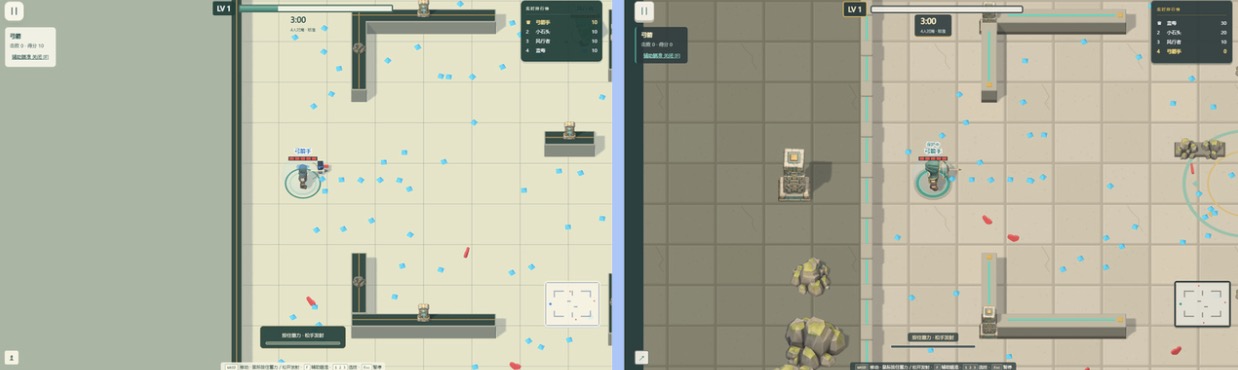
Astra (left) placed most props on top of existing walls. Fable (right) also placed totems and rocks around and beyond the arena’s edges. Both screenshots use the same viewport size. Image courtesy of Vertex Lab.
Two Takes on the Archer
The agents generated their own reference images from the same brief. Astra gave its archer the proportions of an adult adventurer, with a fitted hood, leather armor, and bracers. Fable used a larger head and shorter body, and gave its totems and rocks similarly chunky shapes. Those differences were already visible in the reference images.
Astra’s archer was closer to the adult character described in the brief, but looked small on the lobby stand and stood out beside the game’s blockier cast. Fable’s archer fit more easily into the character lineup. Its teal and gold also carried through to the lobby scenery and interface, though the large totems drew some attention away from the archer.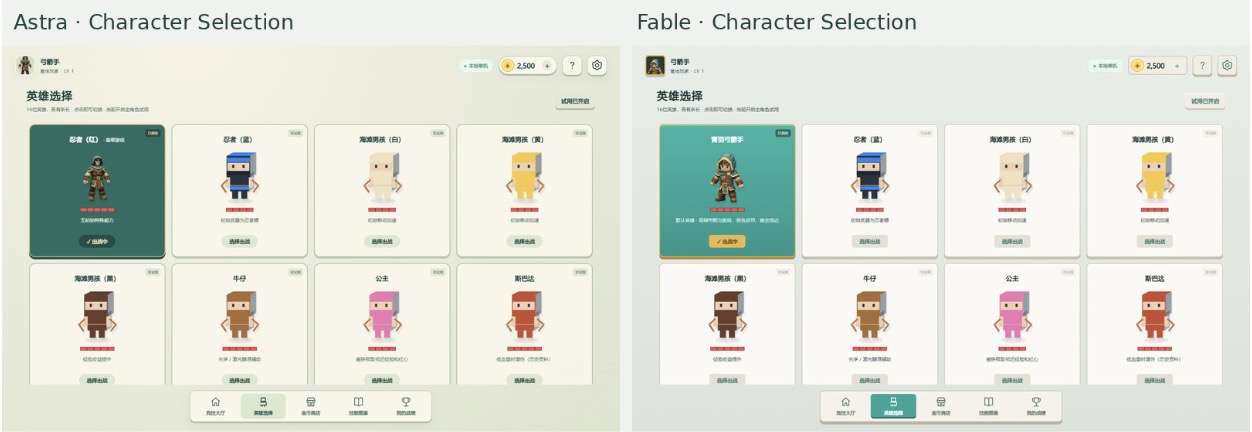
The character selection screens in Astra (left) and Fable (right). The new archer appears in the first card on each screen, alongside the game’s original characters. Image courtesy of Vertex Lab.
Smaller Files, More Geometry on the Map
Vertex Lab compared one final GLB per asset type, then separately counted each totem and rock cluster placed on the four-player map.
| Metric | Astra | Fable |
| Combined size of the three final GLB files | 11.81 MB | 3.88 MB |
| Embedded image data in the GLB files | 8.40 MB | 0.86 MB |
| Prop instances on the four-player map | 12 | 34 |
| Prop triangles on the four-player map, counting every placement | 215,136 | 549,280 |
Embedded images accounted for 7.54 MB of the 7.93 MB file size difference, or about 95%. Fable kept its base color maps at the same resolution as Astra’s, used 512 × 512 maps for roughness and metallic data where Astra used 1024 × 1024, and packed its images as JPEGs. Its three final models had about 8% fewer triangles in total. Its totem alone had more triangles than Astra’s, so the smaller set of files still included a denser version of a prop used repeatedly on the map.
Astra placed most of its totems and rocks on top of existing walls, where they took up little space and their carvings were hard to see from the overhead camera. Fable placed props at corners, around obstacles, and beyond the playable area. Twenty of its 34 props sat outside the playable area and accounted for about half of its prop triangles on the four-player map.
For Astra, the next art pass could bring a few distinctive props into clearer view during a match. For Fable, the repeated rocks and totems beyond the arena are a place to try simpler meshes. The counts cover all prop placements across the map. Frame rate and the number of triangles drawn in a given frame would need separate measurements.
Combat Feedback and Gameplay Checks
In Astra’s build, the ring beneath the archer changed as a shot charged, and the character shifted back when the player released it. Fable added a crouch, a backward lean, and bowstring movement. The two versions also handled hits differently. Astra briefly flashed the character, while Fable made it turn red, compress, and spring back.
Each archer was a single mesh without a skeleton or built-in animation. The game code could tilt the character and move the bowstring separately, but the arms stayed in the same pose. The feedback made it easier to read the shot from overhead. Up close, the archer’s hand still needs to move with the string.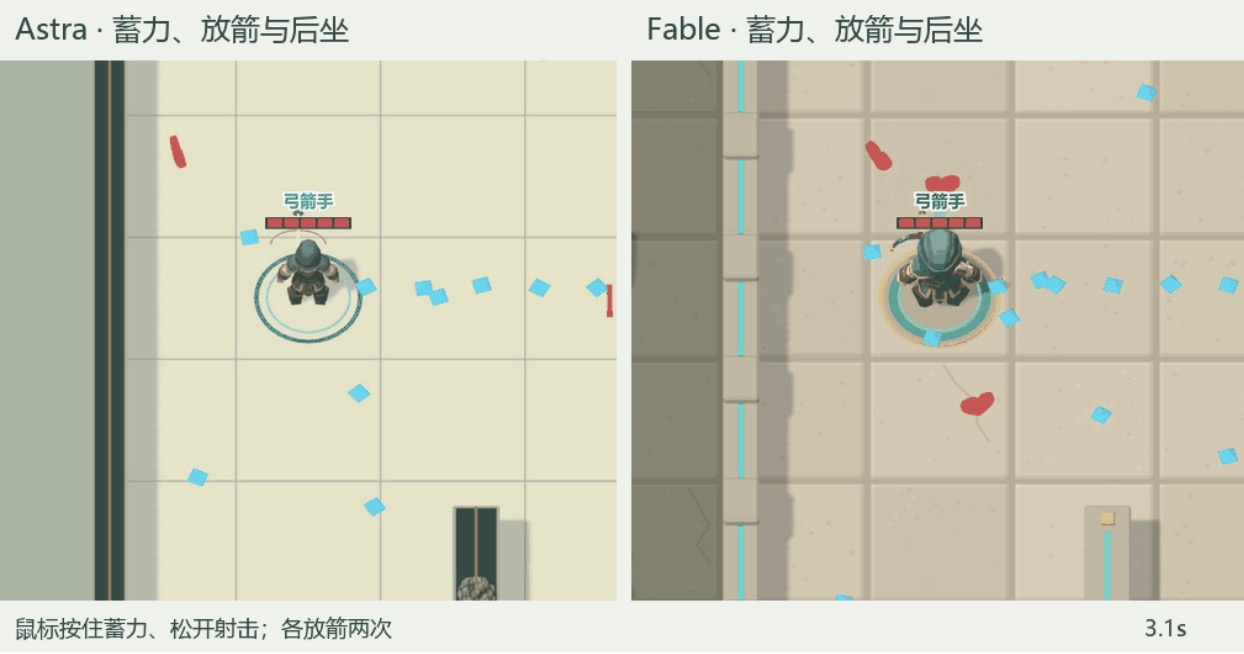
Astra (left) and Fable (right) during a charged shot. The side-by-side view shows the archer’s posture and the charge indicator beneath each character. Image courtesy of Vertex Lab.
Both builds passed the same 38 gameplay regression tests after the update. Vertex Lab also checked that the final exports matched the models used in the game and the offline package. Performance on physical phones and during longer matches remains untested.
The arena test follows Vertex Lab’s sci-fi cavern reconstruction with Astra, Fable, V2Fun, and Blender, where the team checked how the agents assembled a scene and what became visible when the camera moved behind it.
About Vertex Lab and V2Fun
Vertex Lab develops technology for 3D generation and spatial intelligence. Its V2Fun platform offers tools for generating, texturing, and animating 3D assets. Learn more at v2fun.ai.
Media Contact
Vertex Lab
Tammy@vertexlab.ai