Customers now expect instant, accurate answers on chat, email, social, and the phone—often all at once. Ninety-one percent of service leaders say they’re under pressure to deploy AI this year, and modern AI agents can absorb routine work so human teams tackle higher-value conversations.
We sifted analyst reports, ran hands-on tests, and required every shortlisted platform to cover at least three channels, deliver LLM-level intent detection or agent assist, integrate broadly, and meet strict security standards. Anything less didn’t make the cut.
Expect familiar leaders like Zendesk and Intercom plus focused innovators. We’ll also spotlight Comm100, whose unified console and compliance credentials shine in regulated industries.
Ready to match technology to your roadmap? Read on—your agents and your customers will thank you.
How we hand-picked the stand-out platforms

Before we outline each tool, we want to explain how we separated enterprise-ready AI agents from tempting demos.
We began with urgency. Gartner reports that 91 percent of service leaders are under pressure to roll out AI in 2026, so the bar for “best” has climbed.
Next, we reviewed every 2025–2026 “top chatbot” roundup we could find, from analyst briefings to comparison blogs. The most thorough list — Eesel’s 10-platform review — became our baseline for table-stakes features. Anything missing essentials such as omnichannel routing or agent assist was cut.
From there, each contender had to meet five non-negotiables: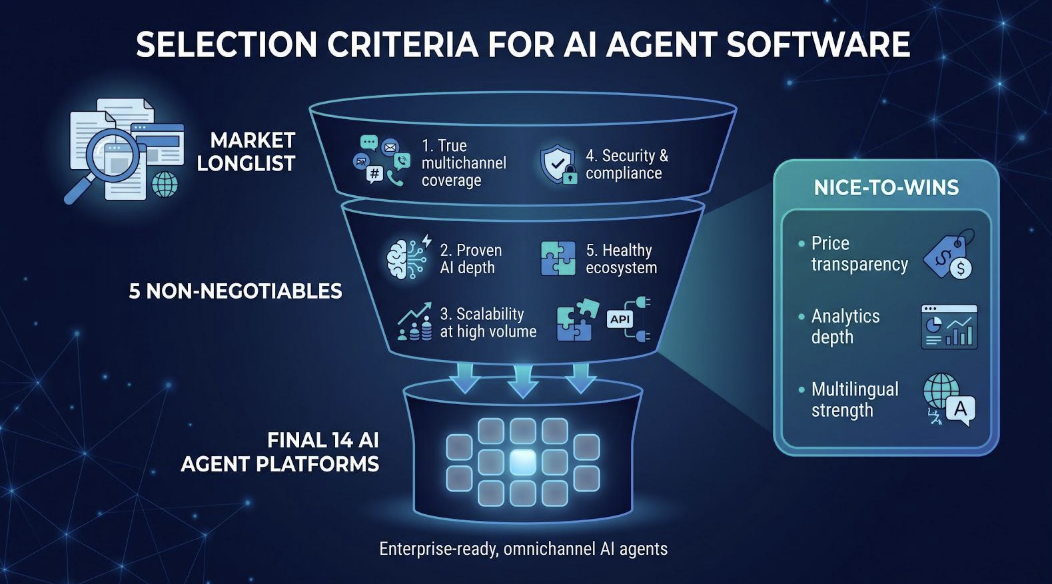
- True multichannel coverage. Support for at least three customer-facing channels—chat, email, social, or voice—inside one console.
- Proven AI depth. Large-language-model intent detection, conversation memory, or agent-assist features that boost resolution rates, not just greet visitors.
- Scalability. Case studies or reference customers handling thousands of monthly tickets without performance dips.
- Security and compliance. SOC 2, ISO 27001, HIPAA, or region-specific data residency options for regulated sectors.
- Healthy ecosystem. Native integrations with CRMs, helpdesks, or open APIs that fit existing tech stacks.
If a platform cleared those checkpoints, we weighed three “nice-to-wins”: price transparency, analytics depth, and multilingual strength. That process produced the 14-tool lineup you’re about to see, grouped so you can jump straight to the options that match your scale, channel mix, and dev resources.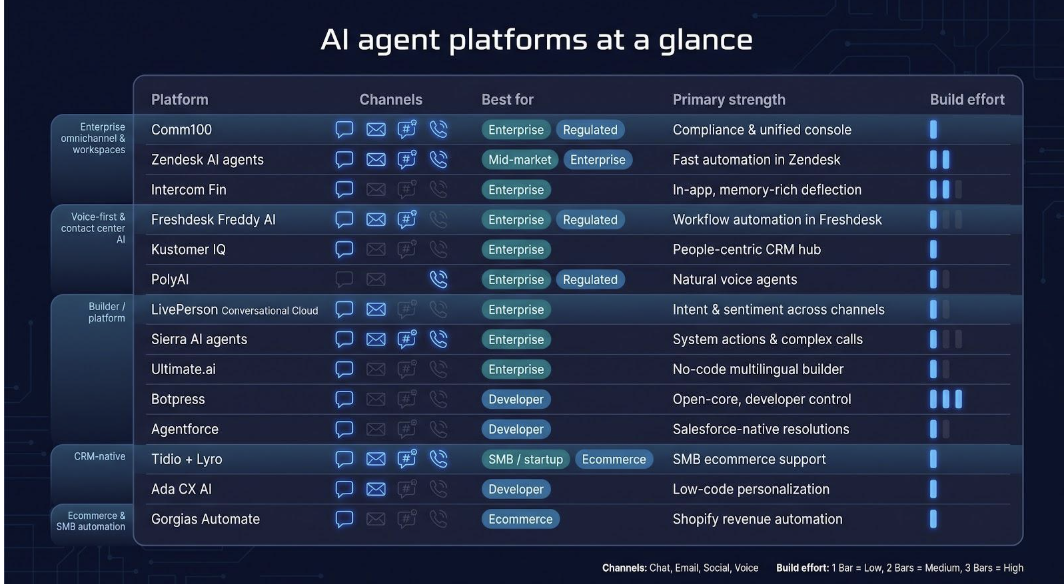
Let’s meet the enterprise omnichannel heavyweights first.
1. Comm100
Independent tests show Comm100’s AI Agent can automate up to 80 percent of inbound queries across chat, email, and voice while maintaining SOC 2 and HIPAA safeguards, earning its place among the Best AI agent software for automating customer support at scale. When you manage regulated data or jump between chat, WhatsApp, and more, you need more than a bot; you need solid protection, and Comm100 provides it.
Its unified console blends live chat, ticketing, social messaging, and a voice-ready AI Agent in one workspace, so your team never switches tabs to keep up.
Comm100 AI Agent unified console screenshot
The AI Suite, introduced in April 2025, handles the routine. The AI Agent deflects common questions, Copilot drafts agent replies and recaps, and managers see sentiment dashboards and automatic QA scores. These features all sit behind SOC 2, ISO 27001, and HIPAA safeguards that appeal to universities and healthcare systems.
Connections are straightforward. Out-of-the-box connectors link to Salesforce, Microsoft Dynamics, ServiceNow, and more. If you need full control, deploy on-premise and keep every byte of customer data inside your firewall.
Try Comm100 with a free 30-day trial and watch your queue shrink.
Zendesk AI agents
Zendesk already holds an established place in many support stacks, so its AI expansion feels more like an upgrade than a shift. The new AI agents come pre-trained on billions of anonymized interactions, which lets them recognize intents and surface answers almost as soon as you switch them on. Add your help-center articles, adjust conversation tone, and they begin deflecting tickets while flagging nuanced issues for humans.
Everything flows through Zendesk’s single workspace. Chat, email, SMS, and social messages land in the same queue, where macros, SLAs, and live context travel with conversations across channels. That continuity shines when customers abandon chat and send a follow-up email an hour later; your agents still see the full timeline.
On the analytics side, Resolution Bot reports show how many tickets the AI closed, phrases it struggled with, and suggested help-center gaps. The feedback loop keeps your knowledge base and bot understanding aligned.
The main caveat is cost clarity. Advanced AI features live in the Suite Professional tier and above, so budget carefully if you run a large agent pool. If Zendesk already anchors your workflow and you want fast, low-friction automation, its AI agents are a practical next step.
Intercom Fin
Intercom earned its reputation in in-app messaging, so Fin feels native from the first “Hello.” After activation, the agent scans your public help center, learns your tone, and resolves up to 67 percent of routine questions without developer help.
Fin’s key advantage is conversation memory. A user can move from your website to a mobile app, ask a follow-up, and Fin recalls the entire thread. That continuity prevents customers from repeating themselves, which matters when they’re already frustrated.
When Fin reaches its limit, it hands the chat to a human with a full context panel and a pre-written summary, so the agent gets straight to problem-solving. Intercom inbox rules then route higher-stakes messages to specialists or create Zendesk tickets if that suits your stack.
Pricing follows a per-resolution model, which is a relief if you’re tired of counting seats. Watch your volume thresholds; the bill climbs once you pass a few thousand monthly resolutions. For product-led teams already using Intercom, Fin offers the fastest path to AI deflection that feels right at home.
Freshdesk Freddy AI
Freshdesk invested in self-service long before generative AI became popular, so Freddy AI feels like a core engine rather than a simple add-on.
Activate Freddy, and it ingests past tickets, FAQ articles, and chat logs. Within hours it predicts intent, surfaces reply suggestions, and, in the new Agent Studio, orchestrates multi-step workflows that tap Shopify, Stripe, or FedEx. You map triggers in a no-code canvas, and Freddy manages the hand-offs, sparing agents the tab-swapping routine.
Freddy also excels in live conversations. When sentiment drops, it alerts a supervisor and highlights possible refunds or escalations. On slower days it auto-summarizes chats so QA teams scan themes instead of transcripts.
Cost scales by agent seat, not resolutions, which helps if you handle large chat volumes with a lean team. The full automation toolset starts at the Pro plan, so plan your budget accordingly.
If you want enterprise-level AI without leaving the Freshworks ecosystem, Freddy offers a tightly integrated path to faster resolutions.
Kustomer IQ
If your team is ready to move past legacy systems such as Salesforce or HubSpot, Kustomer delivers a standalone conversation hub that unifies every customer datapoint. The platform builds a people-centric timeline, merging orders, site visits, and past tickets into one scrolling view. IQ, the AI layer, scans that history to predict intent, suggest macros, and route issues to the correct queue on the first try.
Kustomer excels at proactive context. Agents see payment status, shipping events, and loyalty details before greeting the customer, so they resolve routine questions in a single reply instead of three. IQ also auto-classifies new conversations, trimming triage time and surfacing analytics on emerging issues.
Voice support is built in. Through Twilio and Amazon Connect, inbound calls share the same queue as chats, with IQ proposing answers as customers speak. That parity lets you promise “channel of choice” without adding staff.
Pricing uses a per-user model with optional AI add-ons, which affects midsize teams less than sprawling contact centers. If you want deep CRM hooks and AI that treats every customer personally, Kustomer IQ is worth consideration.
PolyAI
Some customers still prefer the phone, others lack data plans, and many speak faster than they type. PolyAI converts those calls into quick, natural conversations without putting anyone on hold.
Rather than rigid IVR menus, PolyAI voice agents greet callers in plain language, recognise accents across more than 75 languages, and handle tasks from order status to password resets. If a caller talks over the bot, it adapts mid-sentence, much like an experienced rep.
Deployment is fast. Provide call recordings and FAQs, and the platform trains on that data, maps intents, and connects to your contact-center stack through SIP or Twilio. Once live, the agent learns in real time, flags new intents, and passes complex issues to humans with a full transcript.
Teams can set call-length caps, adjust confidence thresholds, and review redacted audio for QA, which supports compliance in finance and healthcare. Pricing is minute-based, so you can scale without adding per-seat fees.
If voice traffic overwhelms your queue or round-the-clock support is hard to staff, PolyAI gives callers responsive help at any hour.
LivePerson conversational cloud
LivePerson spent two decades decoding customer intent across chat and text threads. Conversational Cloud now brings that insight to voice, weaving phone calls, SMS, WhatsApp, and Apple Messages into one AI-guided flow.
Create a voicebot and the platform mines millions of anonymised transcripts to pre-train on common intents. You refine it with brand phrases, connect it to your order or billing system through REST APIs, and launch in weeks, not quarters.
Real-time sentiment scores appear beside every exchange, prompting supervisors to join calls before churn risks grow. When the bot detects fraud cues such as “Why was my card declined again?” it escalates to a human and sends the full voice-to-text log to the agent console, sparing customers from repeating themselves.
LivePerson bills by conversation volume, bundling digital and voice in one contract. The predictability helps finance teams plan, though statutory call-recording rules may still require extra storage.
If you want one workspace for chat and voice, with AI that flags frustration before customers type in all caps, LivePerson deserves a look.
Sierra AI agents
Utilities, telecoms, and airlines depend on complex back-office systems, so support calls are rarely simple. Sierra’s AI agents handle that complexity head-on. A recent partnership with Kraken Technologies lets the agent pull live meter data during a call, confirm usage spikes, and suggest a payment plan before a human joins the line.
Sierra deploys quickly because it uses standard contact-center protocols. Point it at your IVR, feed customer context from a CRM, and set escalation rules. The agent greets callers in natural language, authenticates by voiceprint, and steps through adaptive troubleshooting.
Where Sierra stands out is action. Rather than acting as a conversational layer alone, it writes updates back to billing or scheduling systems through secure APIs. Callers hear a confirmation code and receive an SMS receipt seconds later.
Pricing is consumption-based, so you pay for completed tasks instead of seat licences. For teams facing after-hours calls or seasonal spikes, Sierra adds capacity without adding desks.
Ultimate.ai
Your product changes weekly, so support workflows can’t stay frozen. Ultimate.ai addresses that reality with a no-code builder and an open API that let CX teams ship new intents before the release notes even reach GitHub.
Kickoff is simple. Import chat logs, tag a few dozen examples per intent, and the platform’s language-agnostic engine trains models in 109 languages. That reach is essential if you run follow-the-sun support without dedicated localisation staff.
The Conversation Designer works much like a visual canvas for chat. Drag blocks, set fallbacks, and preview flows with live data. When a customer stumps the bot, Ultimate hands the chat to an agent along with the full decision path, so reps see what happened and fix it quickly.
Developers stay involved. The API exposes everything from n-best intent lists to slot-filled entities, so you can trigger refunds, create RMA labels, or post KPIs to a BI tool. Pricing is enterprise-friendly: a platform fee plus usage-based automation that scales smoothly after you deflect five-figure ticket volumes.
If agility and multilingual coverage lead your must-have list, Ultimate.ai deserves a spot on your shortlist.
Botpress
When you need full control, local hosting, or a chatbot that triggers custom code on the fly, Botpress delivers. Engineers choose this open-core platform when an off-the-shelf bot will not meet complex requirements.
Installation is flexible: deploy to cloud, Docker, or keep it on-prem for strict security. After setup, the visual flow builder lets product managers map conversations while developers insert JavaScript actions inside any node. That blend of drag-and-drop and raw code means you might pull stock levels from an ERP one minute and create a warranty claim the next.
Under the hood, Botpress pairs large-language-model intent detection with rule logic, so you retain deterministic control for compliance steps while still enjoying the range of generative answers. A local vector store caches embeddings, keeping response times short without calling an external LLM for every turn.
Because Botpress is open source at its core, community modules span Twilio Voice, Slack, Telegram, and more. You can join channels, set up webhooks for CRM writes, and monitor performance in real-time analytics. Pricing scales by conversation volume on the hosted plan, or zero if you self-host and only pay for GPU time during fine-tuning.
If you want a transparent platform that adapts to your stack instead of the other way around, Botpress is worth a close look.
Agentforce
Salesforce powers your CRM, CPQ, and marketing journeys, yet when a support question arrives, agents still bounce between tabs. Agentforce solves that by running AI conversations inside the Salesforce UI and charging per successful resolution, not per seat.
Setup starts with connecting Service Cloud data and selecting the objects the bot can read or update. Within minutes, Agentforce ingests knowledge articles, macros, and past cases to build an intent map. Because it lives natively in Salesforce, it can fetch order status or create RMAs without middleware, keeping data governance straightforward.
During a chat, the agent can place an order hold, issue a credit memo, or schedule a field visit through Flow Actions. Each completed action logs to the case, so audit trails stay intact and KPIs roll up automatically.
Pricing is conversation-based at about two dollars per completed interaction. Once your monthly deflection saves more than the per-conversation fee, Agentforce often covers its own cost.
Tidio + Lyro
Small teams need speed, not six-month IT projects. Tidio meets that need with a five-minute widget install and a built-in AI agent called Lyro that starts answering common questions almost immediately.
Connect Shopify, WooCommerce, or Wix, and Lyro ingests product details along with your FAQ page. The bot then fields “Where’s my order?” or “Do you ship to Canada?” without a single rule to maintain. When questions become complex, such as returns on mixed bundles, Lyro hands the chat to a live rep and shows exactly what the customer already asked, so there is no awkward backtracking.
Tidio’s blended inbox is the standout feature. Email, Messenger, Instagram DMs, and web chat all appear in one view, so the same two or three agents can cover every touchpoint without juggling tabs. A lightweight ticketing module tracks follow-ups, and pre-built automations send discount codes to cart-abandoners, lifting revenue while cutting support volume.
Pricing starts with a generous free tier and rises based on AI resolutions. This pay-as-you-grow model lets growing stores test automation risk-free before scaling into busy holiday seasons.
If you sell online and need an instant, no-code boost to response times, Tidio with Lyro delivers enterprise-grade features in an SMB-friendly package.
Ada CX AI
You don’t need a large developer team to launch a sophisticated bot. Ada’s low-code studio lets support managers drag answers, buttons, and images into a flow and publish the same day.
Ada integrates with Shopify, Zendesk, and Salesforce, pulling order or ticket data so the bot can personalise replies. Ask, “Where’s my jacket?” and it returns the tracking link, carrier, and expected delivery without agent input. For subscription brands, Ada can also trace payment issues and prompt customers to update cards on file.
Ada excels at follow-up deflection. If a customer emails after chatting, the bot recognises the prior thread and auto-responds with the missing detail, often before a rep even sees the ticket. That single feature can cut your backlog by double digits.
Pricing is based on automated resolutions with unlimited agents, so scaling stays predictable compared with per-seat models. You pay more only when the bot proves its value by handling greater volume.
For e-commerce and SaaS teams that need strong automation without an engineering queue, Ada turns FAQs into personalised experiences quickly.
Gorgias automate
Shopify merchants rely on Gorgias for its storefront integration. Automate, the platform’s AI layer, resolves tickets before they reach an agent.
Its strength lies in templates tuned for commerce: “Where is my order?”, “Return policy”, “Change shipping address”. Connect your carrier account, set refund rules, and Automate sends tracking links or starts return labels in seconds. Customers receive answers inside chat, email, or Instagram DMs, matching the channel they used first and keeping response times under a minute even on Black Friday.
When Automate needs a human, it tags the ticket with order details, last-chat sentiment, and a suggested reply, so agents concentrate on upsells rather than copy-paste tasks. Managers track deflection and revenue metrics in real-time dashboards linked to Shopify sales data.
Pricing starts around a dollar per automated interaction, capped by plan, which makes it easy to test. If your support team also drives revenue and speed equals money, Gorgias Automate delivers fast gains without adding staff.
Why AI agents win at scale and where they still stumble
AI support is no longer just a cost lever; at scale, it reshapes the entire customer-experience equation.
When bots handle routine questions, human agents move from “Which courier has my parcel?” to higher-value retention work such as upsells or apology credits that safeguard lifetime value. Average handle time falls, first-contact resolution rises, and your CSAT finally climbs.
Leaders also praise consistency. An AI agent never forgets a policy update or misspells a customer’s name, so brand voice stays tight across thousands of daily interactions. With omnichannel context in one thread, shoppers who jump from chat to email avoid repeating themselves, reducing friction that drives churn.
Automation still has limits. Complex account issues, emotional refunds, and edge-case bugs call for human empathy and judgment. Gartner’s 2026 survey shows only 20 percent of service leaders cutting headcount after adding AI; most keep staff steady while volumes grow. Translation: plan for a blended model, not a full hand-off.
Training data hygiene is another hurdle. Feed the bot outdated macros and it will confidently serve wrong answers at scale. Schedule quarterly audits, use conversation analytics to spot drift, and involve product managers in the content pipeline so fixes reach customers before they share screenshots.
Governance also matters. Confirm that your platform logs every action, respects opt-outs, and stores data in the right region. SOC 2 or HIPAA badges on a vendor site are not window dressing; they protect you when legal knocks.
Wrapping up: choose, test, scale
AI agents have moved from buzzword to business backbone. Whether you need enterprise-grade compliance, voice automation for overnight calls, or a plug-and-play bot for a two-person shop, the tools above give you plenty of room to grow.
Start small. Pick one or two high-volume FAQs, launch the bot on a single channel, and track deflection for a month. Use those wins to secure budget, then add new intents and touchpoints. Keep humans involved for coaching and edge-case rescue, and audit knowledge articles quarterly so the AI never feeds customers stale data.
Most vendors offer free trials or usage-based pricing, so experimentation carries little risk. Book demos, ask reps detailed integration questions, and request a sandbox that mirrors production load. The right platform will prove its value long before the contract comes up for signature.
Follow this approach, and you can shift support from a cost center to a growth engine, one smart conversation at a time.