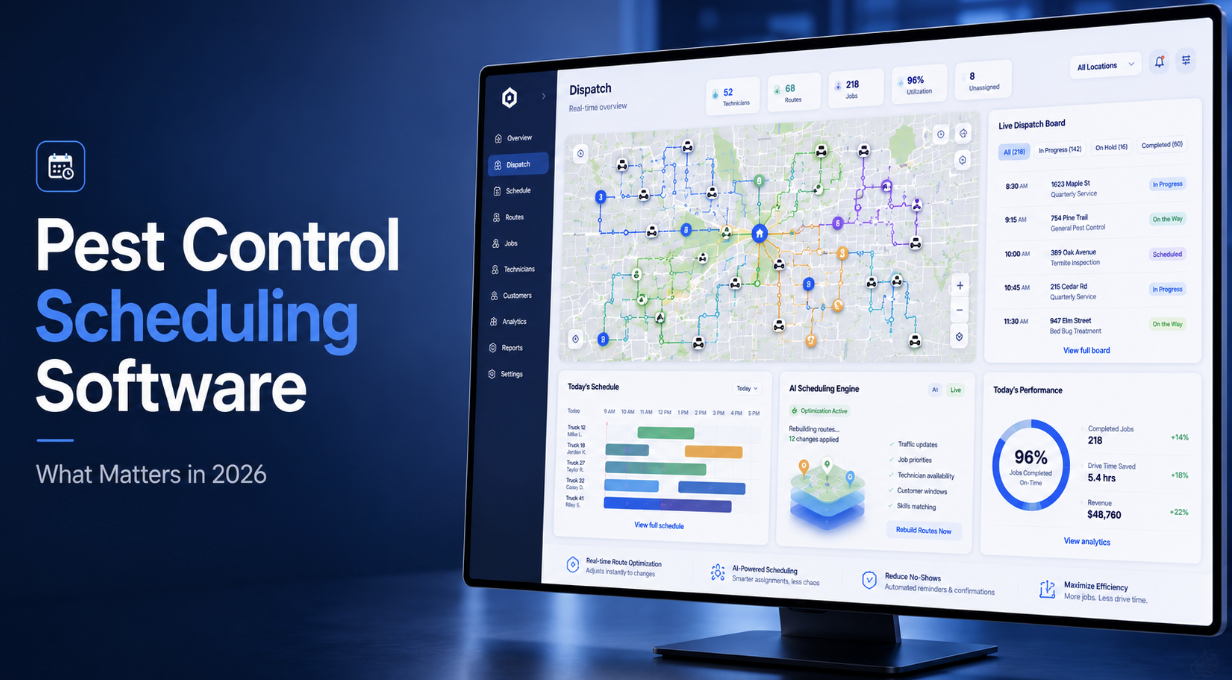
Why Manual Scheduling Breaks at 8+ Trucks
Most growing operations follow the same pattern: the office manager takes calls and writes appointments into a calendar, a dispatcher assigns technicians by gut feel each afternoon, then a single cancellation at 4 PM forces every downstream route to shift. Technicians wait on assignments, no-shows pile up, and revenue leaks.
This holds together until roughly 8 trucks. Past that, the inefficiencies compound. Technicians lose meaningful field time waiting for assignments, one cancellation can cascade across several other jobs, no-show rates climb, and office staff spend the majority of their day on logistics rather than sales.
The economics are significant. A 50-truck operation running manual scheduling can lose many hours daily to coordination overhead, which translates into substantial annual losses through wasted drive time, missed appointments, and idle technician capacity. Pest control scheduling software solves this, but only when it’s built for enterprise scale.
The Scheduling Problem at Different Company Sizes
- 5-10 trucks: Manual scheduling plus a shared calendar works. Spreadsheets are tolerable.
- 11-25 trucks: You need automation. Basic scheduling tools like Jobber or HousecallPro handle this. Real-time dispatch remains optional.
- 26-49 trucks: You need real-time optimization. One cancellation shouldn’t blow up every route. FieldRoutes and PestPac operate well here.
- 50+ trucks: You need AI-native dispatch. Manual optimization becomes impossible and real-time adjustments are mandatory. This is where Solea AI is purpose-built.
If you’re at 50 trucks trying to run Jobber, you’re building on a foundation that can’t hold the weight.
15 Scheduling Factors That Separate Good from Broken
Not all pest control scheduling software is built for enterprise operations. At 50+ trucks, most of the following are requirements, not nice-to-haves.
Dispatch & Route Optimization
- Real-time route rebuilding – A 4 PM cancellation shouldn’t disrupt five other jobs.
- Drive time optimization – Reduce windshield time and recover productive hours across the fleet.
- Emergency job insertion – Fit urgent callbacks into existing routes without creating scheduling chaos.
- Multi-location support – Coordinate technicians across multiple territories and branches.
- AI scheduling agent – Automatically optimize schedules and assignments without constant dispatcher intervention.
Technician Management
- Technician skill matching – Assign specialized jobs to properly certified technicians.
- Mobile app live updates – Route and schedule changes appear instantly in the field.
- Compliance tracking – Monitor certifications, licensing requirements, and chemical inventory.
- Performance analytics – Identify top performers, inefficient routes, and scheduling bottlenecks.
Customer Experience
- No-show prediction – Flag high-risk appointments before they become lost revenue.
- Customer communication automation – Send confirmations, reminders, and arrival notifications automatically.
- CRM integration – Give technicians access to customer history and service notes.
- Customer feedback loop (Nice to Have) – Capture satisfaction data and identify service issues early.
Operational Resilience
- Offline capability – Keep technicians productive even when connectivity drops.
- Dynamic pricing (Nice to Have) – Adjust pricing based on travel distance, demand, and job complexity.
The labor economics make the case even stronger. According to Authority.inc’s analysis of U.S. pest control technician wages, technicians earn an average of 27.5% less than competing trades such as HVAC, plumbing, and electrical work. This compensation gap makes recruiting and retaining qualified technicians one of the industry’s biggest growth constraints.
The Enterprise Requirement: AI-Native at 50+ Trucks
If you’re operating 50+ trucks, you need AI-native scheduling rather than bolt-on features.
Solea is built for this scale: an end-to-end AI Scheduler that optimizes without constant human intervention.
-
No-Show Reduction: The Math That Justifies Software
No-shows are the silent killer of pest control operations at scale. Reduction typically tracks with automation maturity:
- Manual scheduling: highest no-show rates, often in the high teens to low twenties percent range
- Basic management software: moderate improvement
- Automated reminders (SMS plus call): meaningful reduction into single digits
- AI real-time confirmation: lowest rates, typically single digits
For a 50-truck operation scheduling hundreds of jobs weekly, the gap between manual and AI-driven confirmation can recover six figures annually in otherwise lost revenue. The exact figure depends on your ticket size and service mix, but the directional impact is consistent: every percentage point of no-show reduction at enterprise volume is real money.
-
Real-Time vs. Batch Optimization: Why It Matters at Scale
- Batch optimization (daily): Platforms like FieldRoutes rebuild routes overnight. Technicians receive their schedule at 7 AM, but by early afternoon cancellations have eroded it.
- Real-time optimization (continuous): Solea’s AI Scheduler adjusts routes as calls and cancellations come in. When a customer cancels at 4 PM, the system reassigns work across other technicians instantly, preventing cascade failures.
-
Error-Free Dispatch: Eliminating Human Mistakes
Manual dispatch produces predictable, costly errors: assigning a termite job to a technician without WDO certification, routing a tech 45 minutes backward because the dispatcher misjudged geography, or double-booking the same slot.
AI-native scheduling eliminates these. Solea’s Scheduler verifies technician certification against job type automatically, calculates actual drive time rather than straight-line distance, prevents double-booking through real-time conflict detection, and flags physically impossible routes before they reach a technician. The result is a sharp drop in dispatch error rates compared to manual coordination.
The Bottom Line
Your scheduling platform decision comes down to trajectory, not just current size. Run this checklist before committing:
- Map your 24-month growth plan. If you’ll cross 50 trucks, buy for where you’re headed, not where you are. Migrating platforms mid-growth costs weeks of disruption and dirty data.
- Audit your current no-show rate this week. Pull last quarter’s numbers. If you’re above 10%, automated confirmation pays for itself fast.
- Time your dispatch chaos. Track how many hours your office spends rebuilding routes after cancellations. That number is your real cost of batch scheduling.
- Test real-time rerouting in a demo. Ask any vendor to simulate a midday cancellation across multiple trucks. Watch whether routes rebuild instantly or wait for tomorrow.