Few industries have moved this fast in this short a time, and the cannabis industry is just one of them. The industry has become one of the most closely tracked sectors in global commerce, generating billions in tax revenue, supporting hundreds of thousands of jobs, and attracting serious institutional investment from healthcare to consumer goods. The cannabis industry stats for 2025 – 2026 tell a story of an industry now operating on a genuinely different scale, with a different kind of reputation & profits. Whether you’re an investor, a business owner, a healthcare professional, or simply curious about where things stand, this breakdown covers what the numbers actually say. Read below for some rich insights!
The Market Size of the Cannabis Industry in 2025-2026
When we look at the market size & revenue opportunities in the cannabis industry in the year 2026, we get a clear picture where cannabis stats 2025-26 suggest that the revenue is expected to reach up to $47 billion. And the U.S. market size of the cannabis industry, which was estimated at USD 38.5 billion in 2024, is expected to grow at a CAGR of 11.51% until 2030.
This growth is also a reflection of expanding legalization and growing consumer adoption across various product categories. The U.S. is undoubtedly the most dominant market with a wide margin & continue to grow with medical & adult-use segments. And when we look at a bigger picture & for long-term estimates, all the estimates direct toward consistent growth with regulatory enhancements & investments in cannabis based therapeutics, with a shifting mindset of consumers towards seeing cannabis as part of wellness & healthcare. 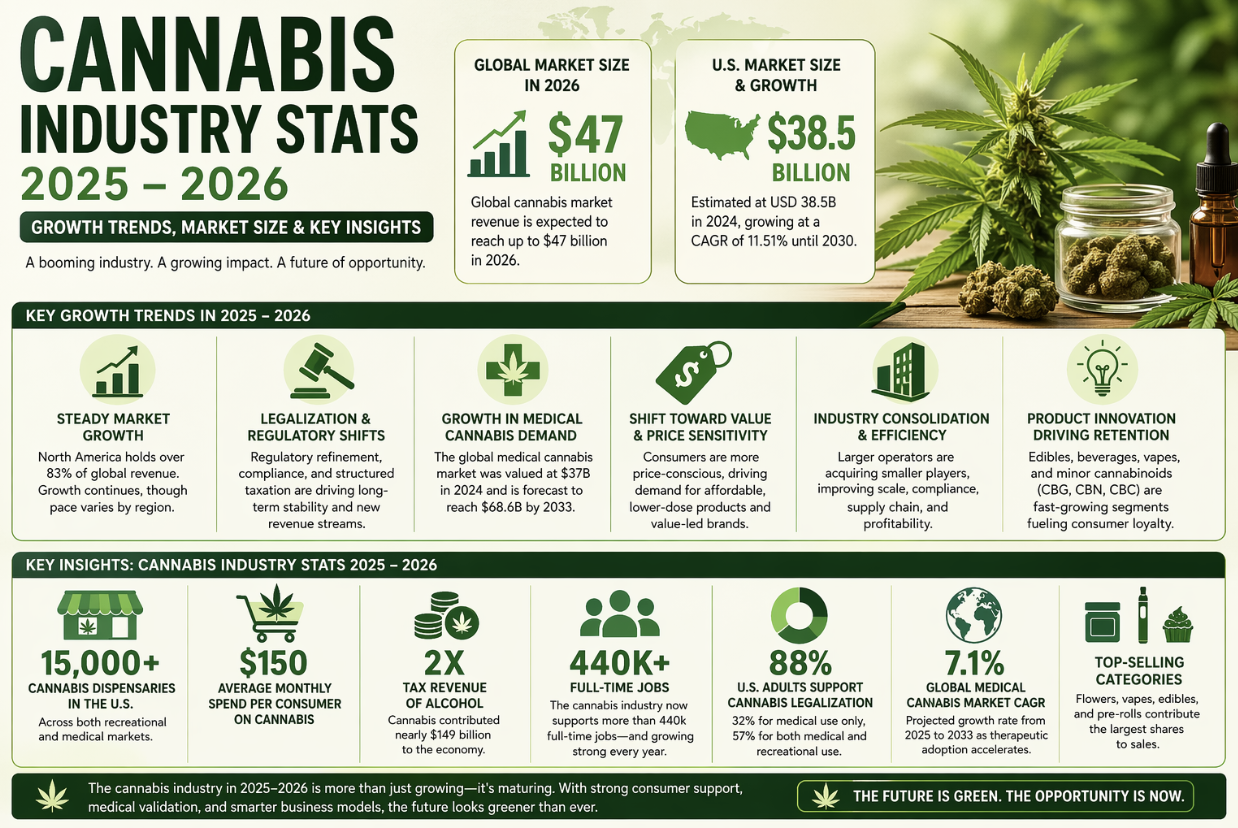
What are the Growth Trends in the Cannabis Industry for 2026?
The cannabis industry stats for 2025 – 2026 show more than just a bigger market; they reflect a more sophisticated one. The trends driving growth this year are structural, not cyclical, and they’re reshaping everything from product development to regulatory frameworks. Here’s where the movement is happening.
Steady Market Growth, Despite Regional Variations
The cannabis industry reflects the consistent growth, market stabilization, operational efficiency, & better regulatory framework. However, when we look at the market growth, we see an upward trajectory, but it is not uniform. North America still accounts for over 83% of global revenue, while newer markets continue to face pricing pressure and supply chain challenges. When we look at the global picture, it is growth, but its pace & profile vary according to jurisdiction.
Legalization Driving New Revenue Streams & Regulatory Shifts
What brings growth in the cannabis industry in 2026 is regulatory refinement, much more than legalization & expansion. The well-laid compliance standards, better licensing systems & structured taxation models are some factors that play a significant role in this progress. Also, these improvements play a significant role in providing long-term stability to this sector. Today, 24 US states allow for the legal adult recreational use of cannabis. And with such regulatory & legal shifts, there is a significant growth for cannabis businesses and consumers.
Growth in Medical Cannabis Demand
Medical cannabis is one of the reliable & expanding segments in 2026. The global medical cannabis market was valued at $37 billion in 2024 and is forecast to reach $68.6 billion by 2033. The growth is being driven primarily by an expanding body of research, increasing physician acceptance, and rising patient-reported outcomes across conditions such as chronic pain, neurological disorders, and mental health. Consumer data also indicates that a majority of users turn to cannabis for relaxation and sleep support, reflecting its growing role in wellness-oriented use cases as well.
Shift Toward Value and Price Sensitivity
Regulated U.S. cannabis sales reached roughly $31–32 billion in 2025, reflecting a market where the growth has moderated, and the competition has intensified. Consumers in 2026 are more price-conscious, which has led to a rise in value-driven purchasing behavior. And due to this trend, brands are pushing to compete on pricing, product consistency, and promotions, while also contributing to margin pressure across the supply chain. This growing preference for lower-dose & affordable products is shaping product development and SKU strategy across dispensaries nationwide.
Industry Consolidation and Operational Efficiency
Consolidation is becoming more common as the market matures today. The years 2025 and 2026 are characterized much more by consolidation rather than just pure expansion. This has led to larger operators with capital access acquiring distressed or overleveraged smaller ops, thereby achieving scale advantages in compliance, supply chain, and distribution. Also, there are now automated compliance and tracking software systems adopted by the licensed producers in the European medical sector to conform with their regulatory standards.
Product Innovation Supporting Consumer Retention
While the growth in the cannabis market is stabilizing, innovation continues to play a significant role. Today, brands are leaning more towards differentiation in their products, improving their formulations & enriching consumers’ experience to create their USPs & retain more & more customers. Product categories beyond flowers are expanding rapidly as consumer preferences shift toward alternative formats. Edibles, beverages, and minor cannabinoids such as CBG, CBN, and CBC are all driving much growth in the sector & are emerging as fast-growing segments.
Key Insights into Cannabis Industry Stats in 2025-2026
The broader data below paints a clear picture of where the cannabis industry stands and where it’s heading. These are the numbers most worth knowing to get a fair idea of the industry’s progress & having insights into where it is heading.
- There are more than 15,000 cannabis dispensaries in the various interior & main regions of the United States.
- It is reported that the average monthly spend of a consumer on cannabis is $150.
- Cannabis’ tax revenue is actually double that of alcohol, and cannabis contributed nearly $149 billion to the economy.
- The cannabis industry now offers more than 440k full-time jobs, & this number is seen to keep increasing per year.
- 88%of U.S. adults support cannabis legalization in some form, either for medical use only (32%) or both medical and recreational use (57%).
- The projected global medical cannabis market by 2033 is expected to grow at a 7.1% CAGR from 2025 as therapeutic adoption accelerates.
- Flowers, vapes, edibles, and pre-rolls were seen as contributing the largest shares to sales.
Conclusion
The cannabis industry stats for the year 2025-2026 provide deep & rich insights into where the industry is heading today. The cannabis industry is no longer a minor industry, but rather is an industry with real scale, employment, and tax contributions. However, the industry is still undergoing various transformations & there are still regional variations, but the growth is closely aligned in a particular direction. For anyone who is actually in this industry or planning to venture into it, these stats offer a clear picture of where it is & where it is moving.