GIS user technology news

News, Business, AI, Technology, IOS, Android, Google, Mobile, GIS, Crypto Currency, Economics

  • Advertising & Sponsored Posts
    • Advertising & Sponsored Posts
    • Submit Press
  • PRESS
    • Submit PR
    • Top Press
    • Business
    • Software
    • Hardware
    • UAV News
    • Mobile Technology
  • FEATURES
    • Around the Web
    • Social Media Features
    • EXPERTS & Guests
    • Tips
    • Infographics
  • Blog
  • Events
  • Shop
  • Tradepubs
  • CAREERS
You are here: Home / * PRESS / Earth Imaging - Remote Sensing / Solar Orbiter on track to launch before next total solar eclipse

Solar Orbiter on track to launch before next total solar eclipse

August 21, 2017 By GISuser

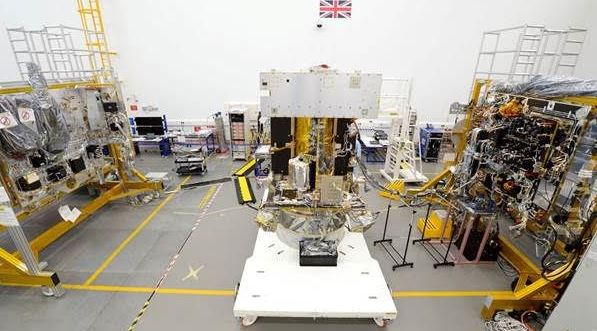
Airbus’ Solar Orbiter in the final stages of integration in Stevenage, UK, and ready for full system electrical testing.  By next eclipse it will be en route to its close-up encounter with our sun!
2017-08-21 19_21_12-Photo Release_ Solar Orbiter on track to launch before next total solar eclipse.

Stevenage, 21/08/2017: Today’s total Solar Eclipse across the United States of America will provide a spectacular view of the mysterious Solar Corona, the one million degree “halo” around the sun, which can only be seen from Earth when the Moon passes in front of the bright solar disk, which otherwise completely drowns out the faint light of the corona.


Scientists lucky enough to be able to see the Solar Eclipse from Earth will be studying this rare glimpse of the corona during the one hundred and sixty seconds or less that the eclipse lasts, to try to answer the many unanswered questions about this mysterious corona.  No-one yet knows for instance, why the corona is more than 100 times hotter than the surface of the Sun.


Meanwhile the European Space Agency spacecraft Solar Orbiter is in the final stages of spacecraft integration at the Airbus spacecraft assembly hall in Stevenage, UK.


Solar Orbiter will be launched in February 2019 into a close orbit around the Sun and will allow scientists to study the solar corona in much more detail, for much longer periods, and at a much closer distance that can ever be reached here on the ground, or for that matter, by any spacecraft circling the Earth. 10 instruments will be flown that will study not only the corona but the Sun’s disk in great detail, the solar wind and the solar magnetic fields which will give us unprecedented insight into how our star works, and how we can better predict periods of stormy “space-weather” that the Sun throws our way from time to time.


The last of the ten instruments is being installed this month and the next step is system testing before the heatshield, antennas and boom are added towards the end of the year.  In addition, the first instrument end-to-end electrical test has been performed successfully showing that the system works completely as expected.


By the time of the next global total eclipse, across the Pacific Ocean and South America on 2nd July 2019, Solar Orbiter will have begun its three and a half year journey to the inner solar system to get close to our Sun.

Filed Under: Earth Imaging - Remote Sensing

Top Press

The Global Expansion of Aueshah: A New Era of High Jewelry

April 11, 2026 By GISuser

KARACHI, PAKISTAN. The international luxury market is experiencing a profound shift. Consumers are increasingly rejecting mass-produced goods in favor of rarity, authenticity, and emotional depth. … [Read More...]

State of Data Science Report – AI and Open Source at Work

September 10, 2025 By GISuser

AI and Open Source at Work … [Read More...]

Topcon Announces Landmark Expansion of Topnet Live Network Across USA

January 26, 2025 By GISuser

LIVERMORE, Calif.---Topcon Positioning Systems has announced a significant expansion of its Topnet Live reference station network, introducing 200 new geodetic stations strategically positioned across … [Read More...]

Space Flight Laboratory (SFL) Announces Launch and Deployment of NorSat-4 Maritime Monitoring Microsatellite

January 19, 2025 By GISuser

Seventh Satellite Developed by SFL for Norway … [Read More...]

HERE and BMW Group extend partnership on AI-powered mapping system

January 8, 2025 By GISuser

HERE and BMW Group extend partnership on AI-powered mapping system for automated driving and enhanced road safety … [Read More...]

Everest Base Camp Helicopter Tour, Helicopter Return Trek, and Manaslu Circuit Trek: Which Nepal Adventure Is Right for You?

November 6, 2026 By GISuser

Almost everyone planning a Nepal trip runs into the same wall. You want the big mountains, you have a fixed number of days, and every itinerary you read seems to promise something … [Read More...]

SFL Missions Inc. Confirms Successful Deployment of Six HawkEye 360 Radio Frequency Detection Satellites with Advanced Capabilities

October 27, 2026 By GISuser

MĀHIA, New Zealand, 26 October 2026 – SFL Missions Inc. today confirmed the successful deployment of six radio frequency (RF) detection and geolocation satellites for HawkEye 360 … [Read More...]

Canadian-Built RoadEng 12 Uses AI to Find the Best Location for New Resource and Rural Roads

October 17, 2026 By GISuser

Vancouver, BC, Canada, October 15, 2026 – North Vancouver-based Softree Technical Systems today released RoadEng Version 12, used in more than 75 countries to locate and design … [Read More...]

Beyond the Map: How AI Image and Video Generation Is Changing Geospatial Communication

October 14, 2026 By GISuser

Ask anyone who has shipped a GIS project what the hardest part was, and the answer is rarely the spatial analysis. It is almost always the communication. A site suitability … [Read More...]

From Maternity to Everyday Wear: Building a Wardrobe That Grows With You

October 14, 2026 By GISuser

When I think about maternity clothing, I feel the biggest mistake is buying too many things at once. During pregnancy, your body keeps changing, and something that fits well today … [Read More...]

Copyright gletham Communications 2015 - 2026

Go to mobile version