For decades astronomers have been puzzled by a gap that lies between neutron stars and black holes, but a major new discovery has found a mystery object in this so-called ‘mass gap’.
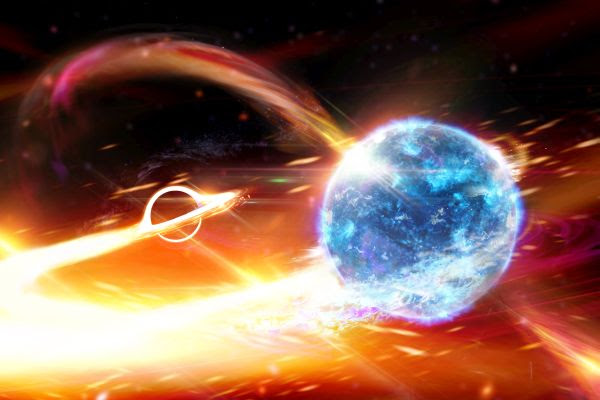
Scientists puzzle over the mysterious astrophysical object: have they discovered the heaviest neutron star or the lightest black hole ever observed?
The gravitational wave group from the University of Portsmouth’s Institute of Cosmology and Gravitation played a key role in the study, which will change how scientists look at neutron stars and black holes.
When the most massive stars die, they collapse under their own gravity and leave behind black holes. When stars that are a bit less massive die, they explode in a supernova and leave behind dense, dead remnants of stars called neutron stars.
Gravitational waves are emitted whenever an asymmetric object accelerates, with the strongest sources of detectable gravitational waves being from the collision of neutron stars and black holes. Both of these objects are created at the end of a massive star’s life.
The heaviest known neutron star is no more than two and a half times the mass of our sun, or 2.5 solar masses, and the lightest known black hole is about five solar masses.
The new study from the National Science Foundation’s Laser Interferometer Gravitational-Wave Observatory (LIGO) and the Virgo detector in Europe, has announced the discovery of an object of 2.6 solar masses, placing it firmly in the mass gap.
LIGO consists of two gravitational-wave detectors which are 3,000 kilometres apart in the USA – one in Livingston, Louisiana, and one in Hanford, Washington. The Virgo detector is in Cascina, Italy.
Dr Laura Nuttall, a gravitational wave expert from the University’s Institute of Cosmology and Gravitation, said: “The reason these findings are so exciting is because we’ve never detected an object with a mass that is firmly inside the theoretical mass gap between neutron stars and black holes before. Is it the lightest black hole or the heaviest neutron star we’ve ever seen?”
Portsmouth PhD student Connor McIsaac ran one of the analyses that computed the significance of this event.
Dr Nuttall added: “Connor’s analysis makes us certain that this is a real astrophysical phenomenon and not some strange instrumental behaviour.”
The object was found on August 14, 2019, as it merged with a black hole of 23 solar masses, generating a splash of gravitational waves detected back on Earth by LIGO and Virgo.
The cosmic merger described in the study, an event dubbed GW190814, resulted in a final black hole about 25 times the mass of the sun (some of the merged mass was converted to a blast of energy in the form of gravitational waves). The newly formed black hole lies about 800 million light-years away from Earth.
Before the two objects merged, their masses differed by a factor of 9, making this the most extreme mass ratio known for a gravitational-wave event. Another recently reported LIGO-Virgo event, called GW190412, occurred between two black holes with a mass ratio of 3:1.
Vicky Kalogera, a professor at Northwestern University, said: “It’s a challenge for current theoretical models to form merging pairs of compact objects with such a large mass ratio in which the low-mass partner resides in the mass gap. This discovery implies these events occur much more often than we predicted, making this a really intriguing low-mass object.
“The mystery object may be a neutron star merging with a black hole, an exciting possibility expected theoretically but not yet confirmed observationally. However, at 2.6 times the mass of our sun, it exceeds modern predictions for the maximum mass of neutron stars, and may instead be the lightest black hole ever detected.”
When the LIGO and Virgo scientists spotted this merger, they immediately sent out an alert to the astronomical community. Dozens of ground- and space-based telescopes followed up in search of light waves generated in the event, but none picked up any signals. So far, such light counterparts to gravitational-wave signals have been seen only once, in an event called GW170817. The event, discovered by the LIGO-Virgo network in August of 2017, involved a fiery collision between two neutron stars that was subsequently witnessed by dozens of telescopes on Earth and in space. Neutron star collisions are messy affairs with matter flung outward in all directions and are thus expected to shine with light. Conversely, black hole mergers, in most circumstances, are thought not to produce light.
According to the LIGO and Virgo scientists, the August 2019 event was not seen by light-based telescopes for a few possible reasons. First, this event was six times farther away than the merger observed in 2017, making it harder to pick up any light signals. Secondly, if the collision involved two black holes, it likely would have not shone with any light. Thirdly, if the object was in fact a neutron star, its 9-fold more massive black-hole partner might have swallowed it whole; a neutron star consumed whole by a black hole would not give off any light.
“I think of Pac-Man eating a little dot,” said Professor Kalogera. “When the masses are highly asymmetric, the smaller neutron star can be eaten in one bite.”
Future observations with LIGO, Virgo, and possibly other telescopes may catch similar events that would help reveal whether the mystery object was a neutron star or a black hole, or whether additional objects exist in the mass gap.
The paper about the detection has been accepted for publication in The Astrophysical Journal Letters.
Credit:
The University of Portsmouth is a progressive and dynamic university with an outstanding reputation for innovative teaching and globally significant research and innovation.
It was rated ‘Gold’ in the UK government’s Teaching Excellence Framework (TEF) and was ranked in the top 150 under 50 in the world according to the Times Higher Education rankings. The University is also 21st in the Guardian’s 2020 league table and was ranked number one in the UK for boosting graduate salaries according to The Economist.
The University’s research and innovation culture is impacting lives today and in the future and addressing local, national and global challenges across science, technology, humanities, business and creative industries. http://www.port.ac.uk/