GIS user technology news

News, Business, AI, Technology, IOS, Android, Google, Mobile, GIS, Crypto Currency, Economics

  • Advertising & Sponsored Posts
    • Advertising & Sponsored Posts
    • Submit Press
  • PRESS
    • Submit PR
    • Top Press
    • Business
    • Software
    • Hardware
    • UAV News
    • Mobile Technology
  • FEATURES
    • Around the Web
    • Social Media Features
    • EXPERTS & Guests
    • Tips
    • Infographics
  • Blog
  • Events
  • Shop
  • Tradepubs
  • CAREERS
You are here: Home / News / Eco friendly and Green Geo Solutions / Global temperatures 19th warmest on record for January

Global temperatures 19th warmest on record for January

March 3, 2012 By Editor


The globe experienced its 19th warmest January since record keeping began in 1880. Arctic sea ice extent was the fourth smallest extent on record for January at 7.5 percent below average. Additionally, La Niña conditions continued during January 2012. According to NOAA’s Climate Prediction Center, La Niña is expected to dissipate during the Northern Hemisphere spring.

January 2012 marks the coolest month since February 2008. However, January 2012 also marks the 26th January and 323rd consecutive month with a global temperature above the 20th century average. The last month with below average temperatures was February 1985.

Global temperature highlights: January

  • The combined global land and ocean average surface temperature for January 2012 was the 19th warmest on record at 54.23°F (12.35°C), which is 0.63°F (0.35°C) above the 20th century average of 53.6°F (12.0°C). The margin of error associated with this temperature is +/- 0.14°F (0.08°C).
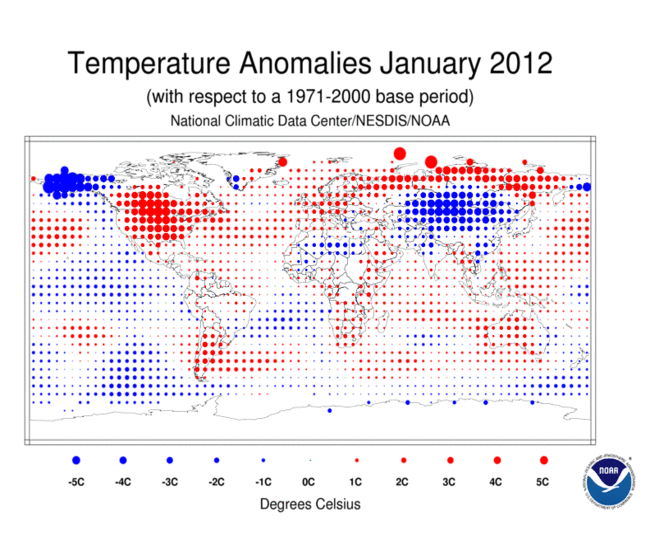
  • January Blended Land and Sea Surface Temperature Anomalies in degrees Celsius
    Surface temperature anomalies for January 2012
  • Separately, the global land surface temperature was 0.88°F (0.49°C) above the 20th century average of 37.0°F (2.8°C), making this the 28th warmest January on record. The margin of error is +/- 0.31°F (0.17°C). Warmer-than-average conditions occurred across most of North America, the northern latitudes of Europe and Asia, southern South America, and most of Australia. Cooler-than-average regions included China, Mongolia, Kazakhstan, south central Russia, much of the Middle East, northern India, north Africa, and southwestern Greenland.
  • The Arctic Oscillation climate pattern played a role in temperatures in the Northern Hemisphere during January. The positive phase during the first half of the month contributed to well-below average monthly temperatures across Alaska and above-average temperatures across the contiguous United States. The negative phase during the second half of the month contributed to warmth in Canada and also to a cold snap that began during the last week in January across Central and Eastern Europe and north Africa.
  • The January global ocean surface temperature was 0.54°F (0.30°C) above the 20th century average of 60.5°F (15.8°C), making it the 17th warmest January on record and coolest monthly ocean temperature since January 2008. The margin of error is +/- 0.07°F (0.04°C). The warmth was most pronounced across the north central and southwestern Atlantic Ocean, the central and western Pacific, and the southeastern Indian Ocean.
Polar Sea Ice and Precipitation Highlights

  • The growth rate for Arctic sea ice in January was the slowest in the satellite record. The average sea ice extent for the month was 7.5 percent below average, ranking as the fourth smallest January extent since satellite records began in 1979. The extent was 425,000 square miles (1.1 million square kilometers) below average. This marks the 19th consecutive January and 128th consecutive month with below-average Arctic sea ice extent.
  • Selected Climate Anomalies and Events Map
    Selected Climate Events for January 2012
  • On the opposite pole, Antarctic sea ice during January was 13.8 percent above average, and the seventh largest sea ice extent on record for the Southern Hemisphere since records began in 1979.
  • Northern Hemisphere snow cover extent during January was slightly above average, with large differences between the North American and Eurasian land areas. Eurasia had its ninth largest snow cover extent in the 46-year period of record, where cold and snowy conditions dominated across central and Eastern Europe, as well as much of China. North America had its third smallest January snow cover extent, where much of the United States and southern Canada were warmer and drier than average, limiting snow cover.
  • Monsoonal rains brought heavier-than-average rainfall to southwestern and southeastern Australia. Precipitation was also much above average in south Asia, part of eastern Russia, and southwestern Greenland. Much drier-than-average conditions were observed across northern Canada, the north central United States, eastern Brazil, and northern Sweden.

See more http://www.ncdc.noaa.gov/sotc/

Filed Under: Eco friendly and Green Geo Solutions Tagged With: Eco friendly and Green Geo Solutions, Global temperatures 19th warmest on record for January, News

About Editor

Glenn is a geographer and a GIS professional with over 20 years experience in the industry. He's the co-founder of GISuser and several other technology web publications.

Top Press

The Global Expansion of Aueshah: A New Era of High Jewelry

April 11, 2026 By GISuser

KARACHI, PAKISTAN. The international luxury market is experiencing a profound shift. Consumers are increasingly rejecting mass-produced goods in favor of rarity, authenticity, and emotional depth. … [Read More...]

State of Data Science Report – AI and Open Source at Work

September 10, 2025 By GISuser

AI and Open Source at Work … [Read More...]

Topcon Announces Landmark Expansion of Topnet Live Network Across USA

January 26, 2025 By GISuser

LIVERMORE, Calif.---Topcon Positioning Systems has announced a significant expansion of its Topnet Live reference station network, introducing 200 new geodetic stations strategically positioned across … [Read More...]

Space Flight Laboratory (SFL) Announces Launch and Deployment of NorSat-4 Maritime Monitoring Microsatellite

January 19, 2025 By GISuser

Seventh Satellite Developed by SFL for Norway … [Read More...]

HERE and BMW Group extend partnership on AI-powered mapping system

January 8, 2025 By GISuser

HERE and BMW Group extend partnership on AI-powered mapping system for automated driving and enhanced road safety … [Read More...]

Everest Base Camp Helicopter Tour, Helicopter Return Trek, and Manaslu Circuit Trek: Which Nepal Adventure Is Right for You?

November 6, 2026 By GISuser

Almost everyone planning a Nepal trip runs into the same wall. You want the big mountains, you have a fixed number of days, and every itinerary you read seems to promise something … [Read More...]

SFL Missions Inc. Confirms Successful Deployment of Six HawkEye 360 Radio Frequency Detection Satellites with Advanced Capabilities

October 27, 2026 By GISuser

MĀHIA, New Zealand, 26 October 2026 – SFL Missions Inc. today confirmed the successful deployment of six radio frequency (RF) detection and geolocation satellites for HawkEye 360 … [Read More...]

Canadian-Built RoadEng 12 Uses AI to Find the Best Location for New Resource and Rural Roads

October 17, 2026 By GISuser

Vancouver, BC, Canada, October 15, 2026 – North Vancouver-based Softree Technical Systems today released RoadEng Version 12, used in more than 75 countries to locate and design … [Read More...]

Beyond the Map: How AI Image and Video Generation Is Changing Geospatial Communication

October 14, 2026 By GISuser

Ask anyone who has shipped a GIS project what the hardest part was, and the answer is rarely the spatial analysis. It is almost always the communication. A site suitability … [Read More...]

From Maternity to Everyday Wear: Building a Wardrobe That Grows With You

October 14, 2026 By GISuser

When I think about maternity clothing, I feel the biggest mistake is buying too many things at once. During pregnancy, your body keeps changing, and something that fits well today … [Read More...]

Copyright gletham Communications 2015 - 2026

Go to mobile version